Introduction
Postoperative perihepatic hematomas are blood-containing collections that may be in the subcapsular region or within the spaces surrounding the organ, occurring as a complication following surgical procedures directly involving the liver, gallbladder, and/or biliary tract [1]. Although uncommon, these complications may represent a significant risk to patient survival if not diagnosed and treated promptly. Cases have been reported in which hematoma formation develops even in the absence of evidence of iatrogenic injury, particularly following procedures such as laparoscopic cholecystectomy [1,2]. The clinical presentation may initially manifest as abdominal pain associated with signs of hypotension and, in some cases, a decrease in hemoglobin levels [2].
Diagnosis initially depends on clinical evaluation and is subsequently supported by imaging assessment. Ultrasound may serve as an initial diagnostic approach due to its accessibility and low cost; however, contrast-enhanced Computed Tomography (CT) is the preferred imaging modality, as it enables assessment of the extent and characteristics of the hematoma, as well as the identification of hepatic injury and/or active bleeding [3].
Prompt identification of the hematoma is essential for determining the appropriate treatment strategy, which may include conservative management, percutaneous drainage, or may require surgical reintervention [4]. Treatment selection is based on several factors, including symptoms, hematoma stability, size, patient comorbidities, and the underlying pathology [5].
The use of fibrinolytic agents for the drainage of fluid collections has been considered a therapeutic option; however, research has primarily focused on the drainage of pleural collections. Limited information is available regarding the use of recombinant human Tissue Plasminogen Activator (t-PA) in abdominal collections [5,6].
The purpose of this clinical case is to present the treatment of a patient with a chronic perihepatic hematoma successfully managed using t-PA, based on the MIST2 fibrinolytic protocol published in the United Kingdom in 2011 by Rahman, N. et al., in which the same fibrinolytic dose was administered for the drainage of pleural effusions, as well as the case report published in Rochester, United States, in 2024 by Naqvi et al., in which fibrinolytic therapy was used for the drainage of an abdominal hematoma [5,6].
Case presentation
A 64-year-old female patient was referred from the General Surgery Department due to a chronic perihepatic hematoma following laparoscopic cholecystectomy, without improvement after percutaneous drainage, which demonstrated low output and no clinical improvement.
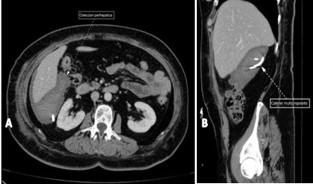
The patient presented for evaluation 40 days after percutaneous drain placement due to persistent right upper quadrant abdominal pain with an intensity of 5/10, without exacerbating or relieving factors. A triphasic abdominal Computed Tomography (CT) scan was performed (Figure 1A), revealing a heterogeneous density perihepatic collection with an attenuation value of up to 61 HU, suggestive of a chronic hematoma, measuring 5.9×8.6×10.3 cm with an approximate volume of 273.8 cc. The tip of the 8.5-Fr drainage catheter was visualized within the collection (Figure 1B).
Based on the imaging findings and with the aim of avoiding further surgical intervention, the decision was made to perform local administration of a thrombolytic agent (Alteplase), a recombinant human Tissue Plasminogen Activator (t-PA), through the multipurpose catheter. Following informed consent from the patient, a dilution of 50 mg of t-PA in 50 mL of 0.9% saline solution was prepared, from which 5 ml was administered, followed by 15 mL of saline solution to facilitate delivery of the agent through the catheter into the collection. After administration, the catheter was clamped for 30 minutes. Doses were repeated twice daily over the following three days, for a total of six doses.
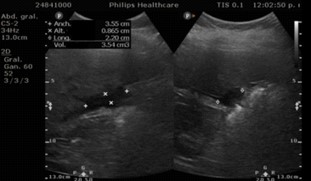
Upon completion of treatment, the patient was asymptomatic, and the drainage bag showed a total output of 300 ml. A follow-up abdominal ultrasound was subsequently performed (Figure 2), demonstrating near-complete resolution of the initially described hematoma, with a quantified residual volume of 3.5 cc. Therefore, removal of the multipurpose catheter was decided, and the patient was discharged without further complications during a follow-up period of up to 12 months.
Discussion
Intra-abdominal hematomas may occur as a complication of surgical procedures and, if left untreated, may become fatal or even become superinfected, leading to abscess formation [1]. This type of delayed collection may potentially be prevented through the placement of intraoperative drains; however, their routine use has not been established. Therefore, when these collections develop, one of the proposed management approaches is percutaneous drainage placement [4,7-10].
The use of fibrinolytic agents in the percutaneous drainage of pleural and abdominal collections has been investigated, employing recombinant human Tissue Plasminogen Activator (t-PA), or Alteplase, which, according to its mechanism of action, has proven effective by disrupting fibrin septations, resulting in resolution of the collection and facilitating continuous drainage through a catheter [8,9].
A literature review was conducted in which several reports were identified describing instillation of this agent for the drainage of intracerebral hematomas, an intra-abdominal hematoma secondary to hiatal hernia repair, and pleural collections [6,9].
Although no specific indications currently exist for fibrinolytic management, and considering the contraindications described for its use, such as coagulopathies or thrombocytopenia, our patient’s case was comprehensively evaluated and, with the aim of preventing surgical reintervention, the decision was made to administer a non-standardized dose previously described in the reviewed literature [7-9]. According to the report published by Rahman, N. M. et al. in 2011, describing the use of t-PA for intrapleural collections, a 1:1 reconstitution of 50 mg of Alteplase with 50 mL of 0.9% saline solution was prepared. A dose of 5 mg of the reconstituted solution was administered directly into the catheter, followed by complete catheter clamping for 60 minutes after administration, repeating this process twice daily for three days until a total of six doses had been completed [5].
This treatment was implemented in our patient, resulting in complete hematoma resolution, as demonstrated on follow-up ultrasound performed 96 hours after initiation of local thrombolysis, with complete clinical improvement and no recurrence of fluid collections during one year of follow-up.
Despite the success achieved with this therapeutic modality, further implementation in a larger number of patients is necessary to establish specific selection criteria to determine in which cases this approach is indicated and/or contraindicated, as well as to better define potential complications associated with catheter placement, including infection, bleeding, and iatrogenic injury to adjacent structures [4].
Conclusion
The use of recombinant human tissue plasminogen activator (t-PA) represents a promising alternative for the treatment of intra-abdominal hematomas; however, a larger number of patients is required to better define which patients are suitable candidates and may derive the greatest benefit from its use.
Declarations
Funding: The authors declare that no funding was received.
Conflict of interes: The authors declare no conflicts of interest related to this article.
References
- Liu Q, Bian L, Sun M, Zhang R, Wang W, Li Y. A rare intrahepatic subcapsular hematoma after laparoscopic cholecystectomy: A case report and literature review. BMC Surg. 2019; 19: 3-5.
- Moloney BM, Hennessy N, O’Malley E, Orefuwa F, McCarthy PA, Collins CG. Subcapsular haematoma following laparoscopic cholecystectomy. BJR Case Rep. 2016; 3: 1-4.
- Yu SH, Park SH, Kim JW, Kim JH, Hwang JH, Park S, et al. Imaging features and interventional treatment for liver injuries and their complications. Korean J Radiol. 2021; 82: 851-861.
- De Filippo M, Puglisi S, D’Amuri F, Gentili F, Paladini I, Carrafiello G, et al. CT-guided percutaneous drainage of abdominopelvic collections: A pictorial essay. Radiol Med. 2021; 126: 1561-1570.
- Rahman NM, Maskell NA, West A, Teoh R, Arnold A, Mackinlay C, et al. Intrapleural use of tissue plasminogen activator and DNase in pleural infection. N Engl J Med. 2011; 365: 518-526.
- Naqvi SJH, Voppuru SR, Wigle D. Use of fibrinolytics for percutaneous drainage of intraabdominal hematoma: A case report. AME Case Rep. 2024; 8: 50.
- Zuckerman DA, Reed MF, Howington JA, Moulton JS. Efficacy of intrapleural tissue-type plasminogen activator in the treatment of loculated parapneumonic effusions. J Vasc Interv Radiol. 2009; 20: 1066-1069.
- Shenoy-Bhangle AS, Gervais DA. Use of fibrinolytics in abdominal and pleural collections. Semin Intervent Radiol. 2012; 29: 264-269.
- Hanley DF, Thompson RE, Muschelli J, Rosenblum M, McBee N, Lane K, et al. Safety and efficacy of minimally invasive surgery plus alteplase in intracerebral haemorrhage evacuation (MISTIE): A randomised, controlled, open-label, phase 2 trial. Lancet Neurol. 2016; 15: 1228-1237.
- Chapa AO, Hernández GM, Pérez TE. Utilidad del uso de drenaje rutinario posterior a la colecistectomía laparoscópica electiva. Estudio prospectivo aleatorizado. Cir Gen. 2024; 46: 26-33.