Introduction
Foaming bath soaps have become a popular choice among parents for children’s bath time due to their playful and engaging nature. Originally introduced in 1965, these products were reintroduced to the market in 2013 by Josh Fink [1]. While generally considered safe for use, many of the ingredients responsible for the product’s foaming effect are highly flammable.
We present a rare case of flash burns in a child following the accidental ignition of foaming soap in the presence of an open candle flame. To our knowledge there is only one other reported case of flash burn injury caused by igniting bath foam in the literature [2]. Therefore, we think this case report is a useful addition to further raise awareness of the flammability risks associated with foaming bath products and using open flames in bathrooms. This case also serves to inform other burns surgeons about this rare cause of flash burn.
Case report
A 7-year-old girl was taking a bath under her mother’s supervision, with open flame candles nearby. Her mother had purchased an aerosol foam spray, “Kids Stuff Crazy Foaming Soap” to create coloured, three-dimensional shapes of bubbles on the water surface that the child could play with during bath time. The foam, mixed with flammable propellant, ignited upon contact with one of the candle flames. While the child’s lower body was submerged underwater, her upper body, arms, and face were exposed.
Her mother poured cool water over her as an initial first aid measure, and the child was then taken the local burns centre for further evaluation and management.
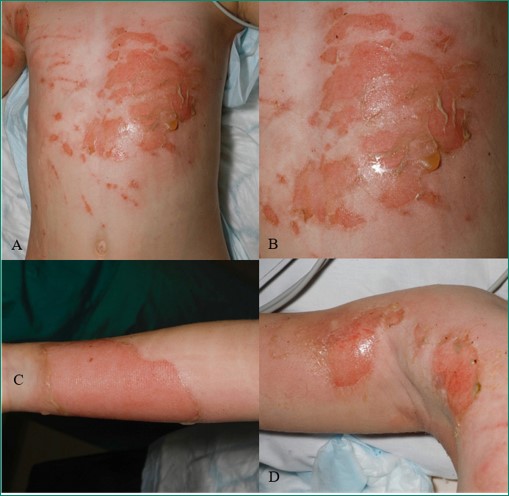
On admission she had 6.5% Total Body Surface Area (TBSA) superficial partial thickness burns to her eyelids, cheeks, right upper limb, right shoulder and left chest (from left nipple to umbilicus) (Figure 1). There was no airway or corneal injury.
She underwent a scrub and application of epiprotect to her face and Biobrane to her trunk and right upper limb (Figure 2). She was discharged home after a 6-day inpatient stay, and followed up as an outpatient 4 days after discharge. The healing time was 18-19 days from date of injury.
Discussion
Bath time is often an enjoyable experience for children, making colourful foaming sprays a popular choice among parents. Likewise, scented candles are frequently used for their perceived therapeutic benefits, enhancing relaxation and creating a soothing atmosphere that elevates the bathing experience. However, many may not be aware of the potential hazards associated with foaming bath sprays, as these products are not typically linked to fire risks, unlike other flammable household items.
Our literature search has only identified one case report describing flame burns secondary to foaming bath bubbles being exposed to a naked flame (candle) [2]. Our case builds on this by reporting a larger TBSA. The previously reported case occurred in 2016 and involved an adolescent who sustained 1.5% superficial partial thickness flash burns to her face, neck, chest and arms. This patient did not have any airway or ocular injuries. This child was managed conservatively with topical paraffin ointments and silicone dressings. However, due to nature of the injury and facial burns, she was admitted for overnight for observation and was discharged 24 hours later.
The spray involved in this incident contains several ingredients, with butane, isobutane, propane, and stearic acid contributing to its high flammability [3]. Additionally, the aerosol system featured by the foaming bubble bath product causes dispersion of the flammable liquid droplets over a larger area than liquid counterparts [4,5]. This larger surface-to-volume ratio increases the product’s flammability and also its susceptibility to cause explosions [4,5].
The product packaging does give advice to keep away from heat, hot surfaces, sparks, open flames and other ignition source, as well as not to spray on an open flame or other ignition source. However, many parents are unaware of this small print. “Keep away from all sources of heat and flames” is written in capital letters on the back of the packaging, however, the consumer’s eye will more likely be drawn to the larger text on the front of the packaging that highlights that the product is “gentle on skin” and is “dermatologically tested”, and that the product can be used in the shower or bath. This product should clearly highlight the specific risk of flash burns on the packaging, as well as the product’s flammability, in a large font and presented in a location that draws the eye more effectively. Similarly, there is also a flammable sign present on the back of the packaging. Such warning signs and text should perhaps be moved to a more visible area like the cap or front surface rather than an area where it may be missed.
We suggest that avoiding flammable bathing solutions and having no open flames within the bathroom are appropriate additions to this list of cautions to prevent further incidences of flash burns from occurring when a child is washed in either the bath or shower. If foaming bath bubbles are being used, this should be in the absence of any naked flames, and under parental supervision.
Conclusion
We present a rare case of flash burns following the accidental ignition of foaming bath bubbles in the presence of an open candle flame. Foaming bath bubbles represent a fun addition to bath-time for many children. Additionally, modern society prioritises ‘self-care’ more than ever before and taking a relaxing candle-lit bubble bath is now a routine act for many. However, they are unaware of the potential hazards of using bathing products with an open flame close by. We hope our report raises awareness of the flammability risks associated with foaming bath products and to emphasize the importance of avoiding open flames (e.g. candles) in bathrooms, particularly when young children are present.
References
- Price M. Crazy Foam aims to tap into nostalgia, clean fun with Superman, Batman, Looney Tunes. Oklahoman. 2024. https://eu.oklahoman.com/story/entertainment/television/2015/09/29/crazy-foam-aims-to-tap-into-nostalgia-clean-fun-with-superman-batman-looneytunes/60719919007/#:~:text=Josh%20Fink%3A%20Crazy%20 Foam% 20 was% 20 launched% 20 in% 201965 % 20 by% 20 the,playful%20essential%20in%20American%20homes.
- Nizamoglu M, Tan A, El-Muttardi N. Bubble bath burns: an unusual case. Case Reports Plast Surg Hand Surg. 2016; 3: 48-9.
- Kids Stuff Crazy Foaming Soap Blue 225ml. (n.d.). Boots. 2024. https://www.boots.com/kids-stuff-crazy-foaming-soap- blue-225ml-10199586?cm_mmc=bmm-buk-google-ppc-_PLAs-_--_-pmax_toiletries gg_shopping pmedia&gad_ source=1&gbraid=0AAAAA-AdmwS89tLasnzcj4SdFl997PZ6K &gclid=Cj0KCQjwmOm3BhC8ARIsAOSbapU1efv2tSClrBwQ7 qVxpKEVKi6r0WeopWAhYX-zQ0GkS2Zy71PpExUaAilsEALw_ wcB&gclsrc=aw.ds
- Lacour M, Le Coultre C. Spray-induced frostbite in a child: a new hazard with novel aerosol propellants. Pediatr Dermatol. 1991; 8: 207-9.
- Moser WJ, Bilka KR, Vrouwe SQ, Glick JC, Ramaiah V. Running water while bathing is a risk factor for pediatric scald burns. Burns. 2023; 49: 1714–1718.